Monday, February 27, 2023

Promoting "Learning" for better results- The value of Learning in NGO programming work

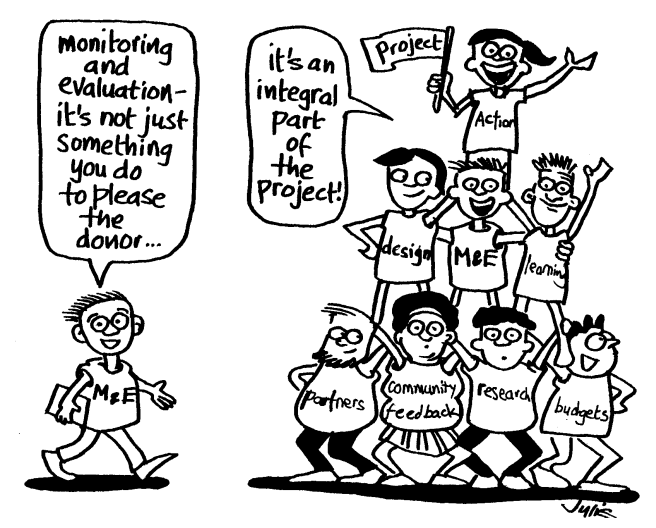
Those in the NGO sector will agree that "learning" is a common term used in the sector. It is quite common to come across NGO posts around learning and adaptation, key terms used to describe processes taken towards programme improvement and success. In this article I want to briefly engage around the concept of Learning, and what it entails in programming work and the overall success of humanitarian and development interventions. 

Briefly linking learning to monitoring and evaluation, it is arguably one of the key reasons for the practice of monitoring and evaluation because at its core, monitoring and evaluation functions seek to provide evidence of progress towards expected results, whilst at the same time identifying bottlenecks, highlighting intended and unintended results and helping programme teams to get answers to their overall assumptions around what works or what does not work. It is through these processes that lessons are derived and used to inform decision making and influence programme adaptation for improved effectiveness and impact.

Learning processes in programming work are a result of applied monitoring and evaluation activities. This means learning must be a deliberate effort for programme teams to pause at regular intervals and reflect upon what they are doing. When programme teams pause and reflect, they gain better understanding of what they are doing, and are better placed to address emerging issues in time, no longer focusing only on the delivery of outputs and results, but drawing their attention to the process of implementation in order to draw lessons and insights that are helpful in improving their programmes now and in the future. Much of programming success is hinged upon the ability to adapt to changing contexts and paradigm shifts, failure of which can lead to the production of redundant results and irrelevant outcomes. 

More often than not, one can differentiate between organizations that invest in learning and those that do not. Organizations that build upon their learning and lessons tend to design better programmes using documented knowledge and lessons from the past; whilst organizations that have not yet caught up to the importance of learning still find themselves designing half-baked interventions that go on to make the same mistakes experienced before and achieve very minimal results. It is therefore critical that practitioners took learning in programming more seriously for the good of programme outcomes and to help bridge the gap between cost and effectiveness of programmes. 

In most cases within the NGO sector, learning is mentioned but largely inactive and therefore non-productive. This is a result of various factors but mostly lack of understanding in the value that learning brings to overall programme success when its used for adaptation, and a general lack of time and financial investment. When learning is done right, many benefits can be realized and some of these include:
  • encouraging continuous programme improvement
  • realization of optimum benefits from scarce resources
  • creation of project memory which is beneficial to other projects
  • providing strategic creation of knowledge and sharing of the same
  • enhancement of skills, expertise and abilities of programme staff.

In order to enjoy the full benefits in the long-term, learning must be premised upon sustainable learning strategies. This means learning must not be a once off event, but should be built upon an organizational culture that allows for learning to happen, whereby learning activities and opportunities are created to last. In this light, there are many opportunities to create a learning culture across programming. Learning can take place at various stages from project level, cross-project level, community level, organizational level, and at inter-organizational/ cluster level. The stages at which an organization chooses to create learning opportunities should be informed by the value it places upon learning and what it expects to gain from the learning opportunities.  

There are practical ways for organizations to promote and support their learning agendas:
  • Investing in learning through budgeting time and money resources 
  • Cultivating a positive mindset towards learning 
  • Focusing on the utility of lessons learned  for programmes adaptation and not just on the documentation of the same 
  • Referring back to past lessons learned during the course of programme implementation when making key programme decisions
  • Referring to past lessons learned during the design of new programmes
  • Creating stable learning opportunities during the design of new programmes and following through 
  • Simplifying learning processes 
  • Willingness to ask the critical but difficult questions: What did we do right? and What did we do wrong?
There is a starting point for organizations new to learning, learned from those who have been implementing learning for a long time and have thus identified some key best practices to successful learning. In order to extract the best benefits from learning activities, organizations should consider applying the following best practices around the creation of a learning culture:
  • Reflect, document, disseminate and utilize both good and bad lessons
  • Create an easily accessible lessons repository file accessible to all team members and relevant stakeholders
  • Keep a central lessons file for better information management and minimization of data leakages around learning
  • Disseminate critical lessons that are key for decision making as soon as possible 
  • Assign a specific person to facilitate and organize all learning activities within the organization, and 
  • Disseminate, disseminate and disseminate lessons. Because learning is only useful when it reaches the right people, at the right time, and is utilized!


By Mangarai Zhou

Sunday, June 2, 2019

Randomized Field Experiments: A Gold Standard in Research?


By Mangarai Zhou
Randomized Field Experiments (RFEs) are used in research, evaluations and assessments to explain a phenomenon. Other research designs include quasi-experiment designs, non-experimental designs, and natural experiments. RFEs have come to be highly regarded to the point of being popularly known as the ‘gold standard’ in research. They are known to have a strong indisputable causal inference which successfully explains attribution in relation to an intervention and its outcomes. RFEs have been in use since the 1920s when they were first introduced by Neyman and in 1925 by Fisher in his controlled experiments to improve farming. The history of RFEs began in the psychology field and gained traction in medical clinical trials before taking the social science sector by storm. The 'gold standard' claims of RFEs come from the belief that they provide more credible evidence than other research designs and has been considerable debate among scholars and researchers over whether RFEs should be the ultimate standard design for research and evaluation over the years. 

The goal of RFEs is to determine if a specific therapy actually makes a positive difference to the people receiving it (Kennedy Institute). RFEs work through the process of comparison between groups whereby one group is the treatment group (receiving complete treatment) and the control group (the untreated group). The control group is the benchmark upon which the effectiveness of the treatment is measured or proved. For better understanding by readers, this article will use a pseudo education development programme where one English literature class was taught using both film and books whilst the other was only taught by reading the literature books. for the purposes of the programme, one single class was divided into two classes using random assignment. The classes had one teacher for the subject and the intervention ran for one month before a test was administered to assess impact. The aim of the intervention was to decide whether film can be used as a method of teaching to improve the pass rate of literature students. After the experiment, the evaluation findings concluded that the intervention of using film to teach literature was effective in increasing the pass rate on the subject, because the class who had film as an extra tool performed far much better than those who only had books. Before intervention, the big class had taken a pretest and obtained a 67% pass rate. A posttest exam revealed the following: the intervention class obtained 92% pass rate whilst the control class obtained a pass rate of 73%. 

The 'gold standard' status of RFEs must be understood largely in terms of linking outcome to intervention, which in this regard they have the capacity to provide rigorous and irrefutable conclusions as they are built on credibility which is based on evidence. They clearly prove that a result may not have happened without the intervention.  The first part of this article will attempt to justify why RFEs are known as the 'gold standard' of all research designs.

At the centre of RFEs is randomization. “The random assignment of subjects to one or another of two groups is the basis for measuring the marginal difference between these groups in the relevant outcome” (Kendall, 2003). The randomness by which participants are chosen into either control or treatment group ensures there is no un-observable characteristics of the units being reflected in the assignment. Randomization also ensures that baseline characteristics, not known to be related to the outcome of interest, are equally distributed among the groups. In the pseudo example used in this article, the students were randomly selected to the two literature classes and each student had a chance of being thrown into either class during selection. This assurance was important to ensure that any differences observed between the two groups can confidently be attributed to the treatment. 
Randomized experimental design yields the most accurate analysis of the effect of an intervention (Gerber et. al, 2003). By randomly assigning subjects to be in the group which receives the treatment (the class using film) or to be in the control group (the class without film), researchers can measure the effect of the film aided teaching method regardless of other factors that may make some people or groups more likely to perform better in their final examinations. 

To bring things into perspective, had the students not been randomly selected but allowed to choose which class they wanted to be in, then the result may not have been enough to attribute it to the intervention, because there are many reasons why a person may choose one thing over another. As such, the students choosing to go into the film class could have been because they are very artistic, love and understand film more than those who would have chosen to go into the control class. This would not have reflected truthfully on the effects of the intervention. Because of the randomization, the results of the film aided education tool were difficult to dispute due to the way that the planning process and execution was planned, which left no room for other variables to do with the participants to distort the findings and this is one of the major strengths of RFEs when used effectively. 

Although other research designs are also able  to highlight the association between outcome and intervention, they are not designed in a way where there is no doubt to the causal relationship.There is always a question when an intervention that did not have any credibility checks in place claims that an outcome was a direct result of an intervention. This doubt is eliminated in RFEs, through randomization which eliminates all systematic differences between participants, strengthening its position as a gold standard in research design.  

When performing experimental research, there are specific control set ups as well as strict conditions to adhere to (Gerber et al, 2003). With these in place, better results can be achieved. With this kind of research, the experiments can be repeated and the results checked again. An interrupted time series design with multiple pre and post tests can be used here to give the researcher a boost of confidence. 

Besides randomization, RFEs also have high internal validity. Their internal validity is enhanced by the fact that all participants have an equal chance of making it into either of the two groups thus reducing bias at the most. In the example, each student stood a chance to make it into the film class or the control class. This reduced or eliminated any possible researcher selection bias which may result from favoritism or bribing.

However, it is important to not take RFEs 'gold standard' claim at face value. Like any other research design, RFEs are riddled with their own limitations. These include questions of appropriateness, external validity, feasibility, ethics, costs among others. Other designs such as triangulation, regression discontinuity designs and interrupted time series design can yield information on causation for far less cost and time than RFEs (Scriven, 2005).

McMillan (2007), emphasizes that doing randomized experiments may be misleading unless attention is paid to three important conditions namely: being sure that the design actually accomplishes the reason for using random assignment – (to achieve statistical equivalence of the experimental and control group prior to, during, and after the intervention is implemented); need to evaluate internal validity on the basis of many factors that are common in field studies; and determining causality, which is why experiments are conducted, is heavily dependent on contextual factors peculiar to each study. 

There are ethical issues involved with RFEs which weaken their 'gold standard' claims. Ethical issues come into play when one considers that RFEs systematically deny a deserving group treatment for the sake of experiment. For one, not every variable that can be manipulated should be, (Behaghel and Zamora, 2012). For example, it would not be appropriate to use RFEs in a research concerned with new treatments for sexually transmitted infections like HIV because  it is not ethical to deny a group treatment which they obviously need and deserve just for the sake of experiment and control. Ethically, the film aided education intervention was wrong for denying the control class the same treatment because at the end of the day this could have affected their overall examination grades in favor of those who were in the treatment class. 

On the other hand, the above point should not be used to crucify RFEs on basis of ethics. The random assignment of participants in RFEs is not always for control of the participants. There are other reasons which justify the random selection and use of a control group. In most cases, financial and administrative resource constraints often do not allow for everyone who could benefit from the program to enroll simultaneously, so randomizing is often the fairest way to allocate treatment order. All eligible beneficiaries have an equal chance of being selected first. This is especially important when participating in programs is highly desirable (Gertler et al., 2011). 

Coming back to their weaknesses, RFEs are subject to experiment effects whereby the researcher knows which subject got what treatment and this may influence how the subjects are treated as well as how effects of the treatment are recorded (Bickman and Reich, 2014). There is a way to counter this threat if researchers have done their homework before commencing an RFE. One of the best ways to counter this would be to use blinding or double-blinding whereby both the researcher and the participants do not know who is receiving what treatment. Double blinding ensures that the preconceived views of subjects and researchers cannot systematically bias the assessment of outcomes (Yale University, 2019). Intention to treat analysis maintains the advantages of random allocation, which may be lost if subjects are excluded from analysis through, for example, withdrawal or failure to comply. Failure to conceal random allocation and the absence of double blinding may yield exaggerated estimates of treatment effects. 

In education studies however, it is often difficult to blind learners to their assigned group. Without blinding, students can react to the knowledge that they are being studied or assigned to a particular group. With or without blinding it may be difficult to prove that the students in the film aided class did not interact with those from the control class and discussed their advantage over the group during their extracurricular activities among other interaction events. There is therefore possibility for contamination which reduces the credibility and validity of RFE results. Contamination of RFE groups normally happens when the organization has not met its promises made to each group, particularly the control group. For example, students from the control class can sneak into the treatment class and watch the literature film so that they also benefit like others if there are no strict enforcement rules in place.  

In other instances, treatment and control groups may be assigned, but compliance to the group assignments may be imperfect. Some participants who were supposed to receive treatment may not get it, or participants in the control group may receive treatment. This can happen “if eligibility cut-offs are not strictly enforced, if selective migration takes place based on treatment status, if there are administrative or implementation errors, if some participants in the treatment group choose not to participate, or for many other reasons” (Gandhi, 2016). 

The issue of blinding of researchers and participants brings to the fore the question of feasibility of RFEs in all research studies. To begin, RFEs were originally derived from clinical research and is now used in education research among other researches. In relation to the film education example used in this essay, the highly complex system of education may be a poor fit for the RFE model, which requires clear inclusion/exclusion criteria and interventions administered identically via multiple physicians (ie, teachers) (Sullivan, 2011). In education studies, variables can rarely be controlled tightly and blinding of subjects and study personnel may be unethical or even impossible. 

RFEs also have shortcomings related to resentful demoralization. Sometimes when the control group finds out that it is not getting the full treatment, it may be demoralized and under-perform. When assessment of results comes, what researchers find will not be a true reflection of the intervention effects, the resultant gap between the control group and the treatment group will be a result of decreased performance by the control group and not necessarily the increased performance by the treatment group. For example, it is possible that the reason for the weaker performance in final examinations by the control class was due to resentful demoralization at having been denied the same chance to watch film as the other class, and not because film enhanced the treatment class students’ understanding of English literature. 

The opposite of the above may happen with RFEs where the control group knows it is being denied full treatment. The control class can develop what is known as a compensatory attitude or effect. Instead of losing morale, they will be motivated to over perform just to prove a point to the treatment group that they can do better than them even with the limited treatment resources. At the end of the day, what the trial concludes would not be a true reflection of the effectiveness or non-effectiveness of the treatment but rather an outcome that has been influenced by other factors. The film evaluation left room for control group students to over perform as they were very much aware of what was happening in the other class and thus possibly affecting the outcome of the program. 

Another major criticism of the RFEs and their 'gold standard' claim is their reduced external validity, against their trusted internal validity. The volunteerism nature and random assignment somewhat limits the generalizability of its findings. “Unless an experiment can be generalized at least a bit, time and resources have been wasted” (Berk, 2005). Although RFEs are regarded as the gold standard with regard to level of evidence, the extent to which their results can be extrapolated to the wider patient population is often questioned, because standardized and controlled study conditions do not adequately reflect clinical reality (Kabisch et al, 2011). 

Norman (2003), argues that RFEs are most useful in examining relatively standardized interventions, such as web-based learning and, possibly, clinical simulation. He argues that one cannot ‘‘apply curriculum daily’’ in the same way that one can prescribe a medication, stressing that RFEs may not be suitable for education research. He recommends that randomization be considered when (1) prior observational studies support the hypothesis; (2) the mechanism of learning is understood; (3) the outcome of the intervention is easily measured and accepted as related to the intervention; (4) the subgroups likely to benefit from the intervention are also easily identified; (5) the effect size of the intervention is small; and (6) the results from the trial may have a large impact, to justify the costs of an RFE. In context, these criteria are not always satisfied in most research studies or interventions and this leaves room to question the 'gold standard' claims of RFEs.

The use of non randomized methods is common in education research and considered by experts as not inferior to RFEs. Sullivan (2011), recommends using longitudinal studies which may use ongoing surveillance or repeated cross-sectional methods to measure change over time. In his view, to strengthen these other research designs, one must include a comparison group. The comparison group may be a concurrent cohort or matched ‘‘case-control’’ format. This will improve the credibility of findings by other research designs which has been viewed as one of the major weaknesses of non randomized research designs. 

Moreover, credibility of findings is highly subjective even with RFEs. The quality of evidence cannot be determined without knowing which questions were asked and why, what evidence was gathered to answer these questions, who asked the questions and gathered the evidence, how the evidence was gathered and analyzed, and under which conditions the evaluation was undertaken (Bickman &Reign, 2014). This means that there is more that is needed to measure credibility than just a study’s design, as is the case with RFEs defenders. In this regard, it can be argued that other non random designs can also be highly credible if they put all the necessary issues into consideration. 

As a solution to finding the most appropriate and highly valid research design, it may be important to combine the strengths of each design, i.e, taking from both random and non random designs and triangulating these in a single research or assessment exercise. Clearly, on their own, RFEs are not always the gold standard in research. However, their random assignment of participants cannot be ignored because it greatly strengthens one's attribution claims. Therefore, researchers should use the RFEs but enhance the validity of their findings by taking into consideration all the possible threats to internal validity which have the potential to weaken an attribution claim.

Saturday, January 12, 2019

Evaluability Assessments: A Good Strategy?


Image result for assessment and evaluation

The evaluability assessment is an evaluation strategy which is also known as a clarificatory evaluation. The strategy is a process of examining the extent to which a program or project can be evaluated in a reliable and credible manner.  It informs whether or not your project is ready for an evaluation, preparing an organization to ensure that a planned evaluation will produce useful and relevant results. It is there to clarify all the necessary issues and information before you begin to carry out an evaluation for your project.

The evaluability assessment is an underutilized strategy in project management. It is fair to state that most NGOs do not carry out evaluability assessments. Focus has mainly been on carrying out actual project evaluations particularly the most common ones, (baseline assessments, midterm evaluations , impact assessments and end of term evaluations) without carrying out any preparatory work to ensure successful evaluations. At the end of the day, most evaluation findings have been substandard, lacking credibility and 'useless', because they have not been properly planned for. This is where an evaluability assessment comes in. The strategy if executed correctly can be the distinguishing factor between a successful and an unsuccessful evaluation. In this case, an unsuccessful evaluation would be one where evaluation findings do not answer stakeholder questions, findings are not conclusive and are not credible.

As far as the quality of an evaluation report is concerned, an evaluability assessment should be a prerequisite to carrying out project evaluations. The benefits that come from carrying out the assessment can not be overstated. They include the ones listed below:
  • An evaluability assessment will inform the timing of your evaluations (whether to wait, proceed or not proceed with a planned evaluation).
  • Prepares a program or project to generate all the necessary information that will be needed for all evaluation questions to be answered. This enhances the credibility of the evaluation findings.
  • Fills the gaps that may have been left out during program design and M and E planning.
  • Will inform you if the program or project is not ready for evaluation.
  • Improves the prospects of an evaluation yielding useful results.
  • Informs better allocation of scarce resources.
  • Treats the 'ritualization' of evaluation processes.
  • Can be used to reconcile differences between stakeholders and evaluators thus increasing the probability of successful evaluations.
The benefits of the assessment cover three important aspects of a program or project: the program design (analysis and or development of logic models and program theories), availability of relevant information, and context (is the context conducive to carry out an evaluation that is credible?)

Foregoing an evaluability assessment may seem like a great idea until you get into a situation where you have evaluations that do not offer any solutions because the evaluator could not obtain all the necessary information they needed to answer your evaluation questions or because the program's objectives were not SMART enough among many other issues. An evaluability assessment will help define the actual objectives of a program and measure the coherence or linkages between the objectives, activities, outputs and outcomes of the program.

The steps to consider when carrying out the Evaluability Assessment
1. Determine Purpose, Secure Commitment, and Identify Work Group Members. 
2. Define boundaries of Program to be Studied. 
3. Identify and Analyze Program Documents. 
4. Develop/Clarify Program Theory. 
5. Identify and Interview Stakeholders. 
6. Describe Stakeholder Perceptions of Program. 
7. Identify Stakeholder Needs, Concerns, and Differences in Perceptions. 
8. Determine Plausibility of Program Model. 
9. Draw Conclusions and Make Recommendations. 
10. Plan Specific Steps for Utilization of EA Data. 

The evaluability assessment is therefore useful to ensure the realization of quality evaluations. It will not only save you from wasting scarce resources on 'useless' evaluations but will add value to project management by identifying and correcting any shortfalls which may have occurred during project design. Most importantly it will help develop a robust logic model and program theory for the project. 


Wednesday, December 26, 2018

M &E for NGOs only? NO, And Here Is Why You Need It Too.


Related image
From IFRC, M &E Guide (2011)

Monitoring and evaluation is at the center of all projects in the non-governmental sector. From the momentum it has gained and continues to garner, maybe it is high time that governments and the profit making sector embraced the concept too, particularly because of its value to project and program success. 

In very simple terms, monitoring and evaluation are processes which are used to improve a project or program's performance and achieve results. More precisely, monitoring refers to the routine collection and analysis of information to track progress against set plans, and check compliance to established standards. The aim of monitoring is to regularly inform management and stakeholders of what is happening on the ground and inform decision making. On the other hand, evaluation refers to a systematic and objective assessment of an ongoing or completed project, program or policy, its design, implementation and results. Its aim is to determine the relevance, efficiency, effectiveness, impact and sustainability of a program or project in the fulfillment of its objectives and development goals. 

Some of the glaring reasons why any organization, government or private company implementing projects or programs should consider having a monitoring and evaluation team include the following:

  • you will know early if you are making mistakes and correct them accordingly. 
  • you will receive accurate, evidence based reports to inform decision making and improve project performance. 
  • you will build organizational learning and knowledge sharing by reflecting upon and sharing experiences and lessons.
  • you will be able to track any changes made during the implementation period for reference purposes.
  • you will uphold accountability and compliance by demonstrating whether or not work has been carried out as agreed and in compliance with established standards.
  • you will provide opportunities for stakeholder feedback, beneficiaries and clients to provide input into and give perceptions of your work. This will model openness to criticism, and willingness to learn from experiences and to adapt to changing needs. 
  • you will promote and celebrate your work by highlighting your achievements thus building morale and team work. 

One of the biggest misconceptions is that monitoring and evaluation is only limited and valuable  to non-governmental organizations, and that it is of no value to governments and profit making organizations. However, what the non-governmental sector is gaining from their monitoring and evaluation systems is exactly what every government and business strives to achieve; SUCCESS! 

Monitoring and evaluation is not only a valuable management tool but also serves to ensure both transparency and accountability from project start to completion. An implementer will know what inputs they have, what each input has produced, the quality of products produced and whether the products serve their intended purpose or not, the hows and the whys. An organization must be accountable to itself (e.g to its board of directors) but also to those from where its resources are sourced. These could be taxpayers, clients, as well as donors. While this strengthens the relationship between an organization and its sponsors, donors and clients, it also builds trust for a more sustainable relationship. 

There is nothing worse than having your sponsors, donors or clients not understand and even get confused about what their money and other resources were used for after they see the finished product. It is every implementer's dream and goal to be celebrated for a job well done and that stakeholders are fully satisfied with the final product, project monitoring and evaluation ensures that!

The beauty of incorporating monitoring and evaluation into your projects is that it increases efficiency and effectiveness. Project managers will be able to identify mistakes, gaps and errors early and as result make quick but informed decisions on whether to continue with a project; correct the mistakes or terminate the project altogether. Such a situation will greatly save an organization from failure and from wasting scarce resources whilst at the same time increasing the chances of success for future projects. When a monitoring and evaluation system is in place, every stage of implementation is scrutinized and weighted against set goals thus eliminating chances for failure or substandard results.

Implementing a project without a monitoring and evaluation plan is like taking a road trip to nowhere but with expectations, you know you will get somewhere but have no idea if your final destination will be exactly as you anticipated. Thus having a project plan is not enough, a monitoring and evaluation plan is needed to ensure the success of the project plan. 

From the very beginning at project design stage, a monitoring and evaluation plan will show you what success will look like, and so when you are headed for failure, you will see it! This is because in the planning stage, a monitoring and evaluation plan will clearly articulate the indicators for each output and each outcome. As a result, the project team and all stakeholders are on the same level of understanding as to what they expect to see as success and hence any output and outcome that does not satisfy its indicator is questioned and scrutinized.  

For the government of Zimbabwe, one cannot help but wonder if monitoring and evaluation is the missing link in the continued failure of most if not all its past and present programs. From the land reform program of the 1980s and the fast track land reform of 2001; Zim-Asset of 2013; to the most recent Command Agriculture, the monitoring and evaluation aspect is silent. Just as democracy requires checks and balances for those in power to operate effectively, project and program success require checks and balances in the form of monitoring and evaluation in order to track and measure success and failure, answer the hows and whys.

Having said all the above, it cannot be disputed that monitoring and evaluation is a necessary management tool which must be adopted and utilized by all success oriented governments, organizations and managers. The costs of setting up a monitoring and evaluation system and hiring a team to do the job may seem like an unnecessary burden when one has no full understanding of the benefits offered by monitoring and evaluation. It is in the best interests of all organizations profit making or not-for-profit, to consider investing in a monitoring and evaluation team that will set up a monitoring and evaluation system and consequently set you up for success. Also remember, monitoring and evaluation data is only relevant when it is utilized. And No, monitoring and evaluation is not a thing for NGOs only, it is for all those committed to success!


Sources:
  • IFRC. (2011). Project/programme monitoring and evaluation (M&E) guide. IFRC, Geneva\ (www.ifrc.com). 
  • Frankel N., and A. Gage. (2007). M&E fundamentals, a self-guided mini-course. Chapel Hill, NC.


Promoting "Learning" for better results- The value of Learning in NGO programming work

Those in the NGO sector will agree that "learning" is a common term used in the sector. It is quite common to come across NGO post...